
Table of Contents
Flowers provide all the food bees need, they feed on both the nectar and pollen of the flowers. The nectar is the sweet substance that flowers produce – its role is in fact to attract pollinators to the flowers. The pollen is a powder that contains the male genetics of the plant. So, the worker bees collect the nectar and they take back to the colony making it into honey. Wildflowers are the most available for bees as they tend to grow outside of urban areas. Depending on how much food is available to them, bee colonies can grow and stay within healthy numbers. Unfortunately, we know that in general, pollinator numbers are declining with all other insects. This is absolutely terrible news for us humans too, as we depend on pollinators too: an estimated about one-third of our food is pollinated by animals.
The good news is, however, that wildflowers are easy to grow. They don’t mind soil quality as much as cultivated flowers and can be more tolerant to extremes as well. If they settle in your dedicated wildflower growing area, they will contribute to biodiversity as just one wildflower meadow can home 100 different species of wildflower and 160 species of insects, which in turn support mammals and birds.
In this listicle, I collected native wildflowers in the UK that you can grow to help to feed the bees. By planting bee-friendly flowers in our garden we can help all pollinators and wildflowers are great for this. You can decide to grow a mini meadow in your garden, have a jewel garden or using wildflowers strategically to complement other plants in your garden.
1 Bellflower
Also known as campanula, these beautiful and royal looking purple flowers almost make you think they are cultivated for their looks. Some of them prefer full sun and other types like some shade.
Flowers: from June to August
2 Betony
The pollinators love these striking purple flowers. Member of the mint family and commonly used in herbal medicine (The Romans used it for over 40 illnesses!), this flower is easy to grow from seed. They like part shade.
Flowers: from June to October
3 Bugle
This herbaceous flowering plant with blue flowers doesn’t really mind different conditions like sun or shade but needs watering sometimes as it prefers wet soil. Its foliage is evergreen, which is a bonus!
Flowers: from April to July
4 Common knapweed
Really sturdy plant, can grow well in different soils. A firm favourite of our pollinators and looks a lot like thistle. Popular in herbal medicine, it is has been used to treat wounds and bruises as well as even sore throat.
Flowers: from June to September
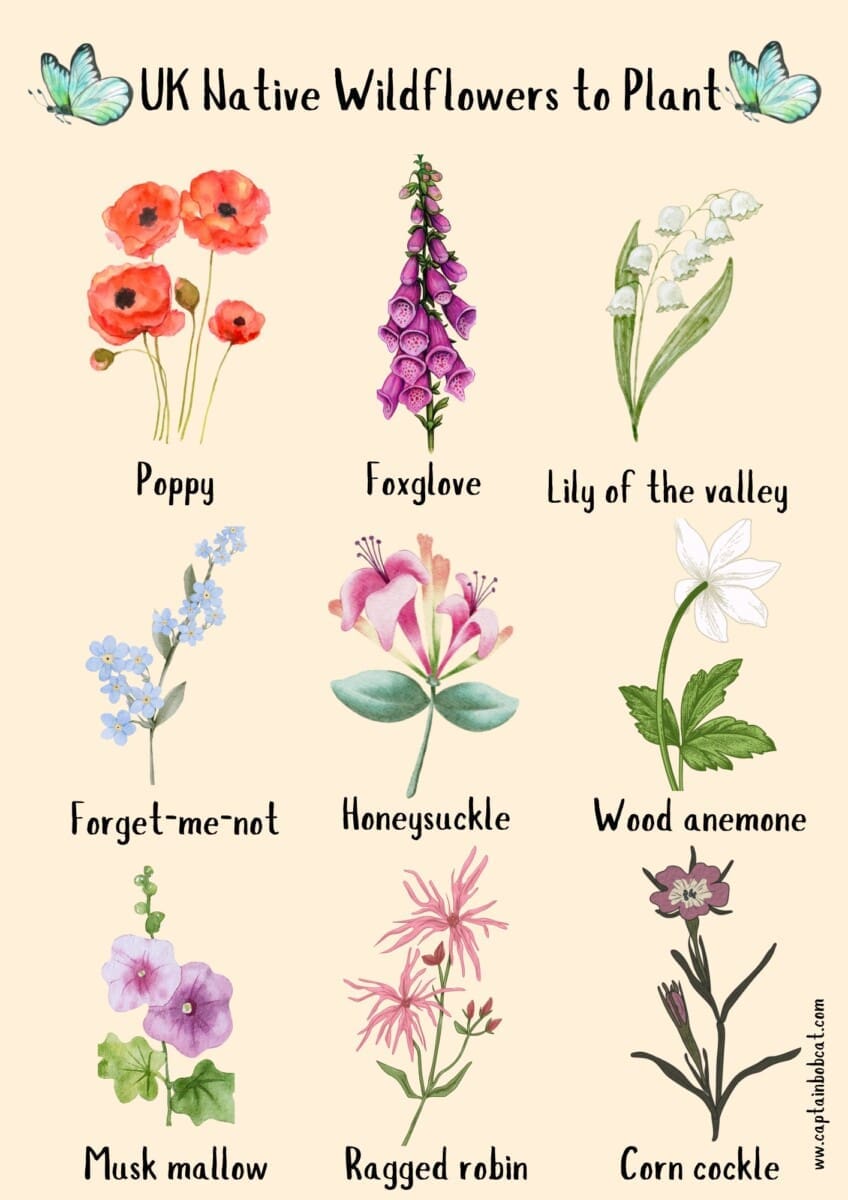
5 Common poppy
The beloved poppy flower is the jewel of the garden and mini meadow when in bloom. It loves well-drained fertile soil in full sun. Poppy seeds aren’t only edible, but very popular and nutritious food.
Flowers: from June to August
6 Corn cockle
Loves well drained soil and full sun, this little pink flower is very attractive to pollinators and self seeds. You can even use them as cut flowers.
Flowers: from June to August
7 Corn marigold
Striking bright golden blooms that love direct sunlight and do well on most free-draining soils. Very beneficial for bees and other insects.
Flowers: from May to September
8 Forget-me-not
Very common biennial wildflower with little baby-blue cluster of flowers. It prefers shade over sun and moist soil as it’s native to ancient and wet woodlands. As the name suggests, it’s a symbol of true love and so it used to be a very popular bridal flower.
Flowers: from April to June
9 Foxglove
A striking, tall flowering plant with tubular purple, pink, dark pink and white flowers. Bumblebees love them. Foxgloves will grow happily in a wooded or shady site but will tolerate most aspects.
Flowers: from May to August
10 Honeysuckle
Did you know that honeysuckle is a native wildflower in the UK? Pollinators love it for its fragrant pink, yellow and white flowers. It’s common and hardy: survives in different of habitats and conditions.
Flowers: from February to November
11 Lily of the valley
Early flowering, extremely fragrant native wildflower that is ancient and wet woodlands. It spreads quickly given the right conditions. Its bright red berries are poisonous.
Flowers: from February to May
12 Meadow cranesbill
Also known as wild geranium. Pretty purple flowers (can be blue or white too) that prefer light shade and loved by most pollinators.
Flowers: from June to September
13 Musk mallow
Offering numerous soft rose-pink flowers when in bloom, this musky-scented perennial is a bee-magnet. Careful: it’s harmful if eaten.
Flowers: June to September
14 Orpine
With dark pink and star-shaped flowers, this herbaceous plant also provides some nice foliage. Likes a well-drained soil. It has been used for medicinal purposes for centuries.
Flowers: from July to September
15 Ox-eye daisy
Very common, because it’s quite a happy little white flower that can tolerate different garden soils as long as it gets enough sun. For this reason it can be quite invasive and spread quickly.
Flowers: from June to August
16 Pasque flower
Produces intense dark pink and purple flowers with ferny foliage. Likes well-drained soil in full sun. Its name is originated from Easter (Pasque) as it tend to pop up around Easter. Pasque flower is now a very rare plant in the wild, unfortunately.
Flowers: from March to May
17 Primrose
One of the first spring flowers with pastel yellow petals and pollinators love this little flower. It’s hardy and it’s widespread – which is good because rare species like the caterpillars of the rare Duke of Burgundy butterfly feed on them.
Flowers: from December to May
18 Purple loosestrife
As in the name: purple clusters of flowers on this robust herbaceous, an old world plant, that prefers moist soil and full sun. Good spreader: self-seeds freely. Loved by pollinators.
Flowers: from July to August
19 Ragged robin
Cute pink flowers and normally likes rain and wet soil as it’s native to wetland meadows. Unfortunately, as wetlands are increasingly disappear so as is ragged robin, which makes it even more important to include it in your wildflower selection if you can. The bees and butterflies love this flower.
Flowers: from May to August
20 Viper’s bugloss
Producing vibrant blue-purple flowers, viper’s bugloss prefers a sunny and dry spot in the garden. Its spotted stem is thought to resemble a viper – hence its name.
Flowers: from May to September
21 Wood anemone
Belonging to the buttercup family, these pretty white flowers are native to ancient woodlands. It likes part shade. Many cultivated variety of the native plant exist.
Flowers: March and May
If you liked this article check out my other garden flower articles:
28 Flowers to Plant for The Bees
20 Common Edible Flowers You Can Plant in Your Garden