
Table of Contents
Many-many times, whenever I wanted to match a frame to a newly found art piece I just got from Ebay or Vinted, I had to look up the correct sizing in different places to make sure I am ordering the correct size. This quest inspired this blog post: let’s have all the measurements in one place: on my blog, so I can just look it up from now. And of course, hopefully you’ll find this useful too, so I included visual chart as well.
When it comes to printing, writing, or crafting, understanding the different paper sizes and their measurements is important. Paper sizes are classified into various formats based on geographic standards, with the most common being the Imperial and Metric systems. In this article, we will explore different paper sizes, their uses, and the corresponding measurements in both systems.
Overview of Paper Sizes and Chart
Paper sizes can vary significantly depending on the region. Generally speaking, the United States predominantly uses the Imperial system, while most other countries follow the Metric system, particularly the ISO (International Organization for Standardization) A series. Each paper size serves a specific purpose, from everyday printing to professional projects.
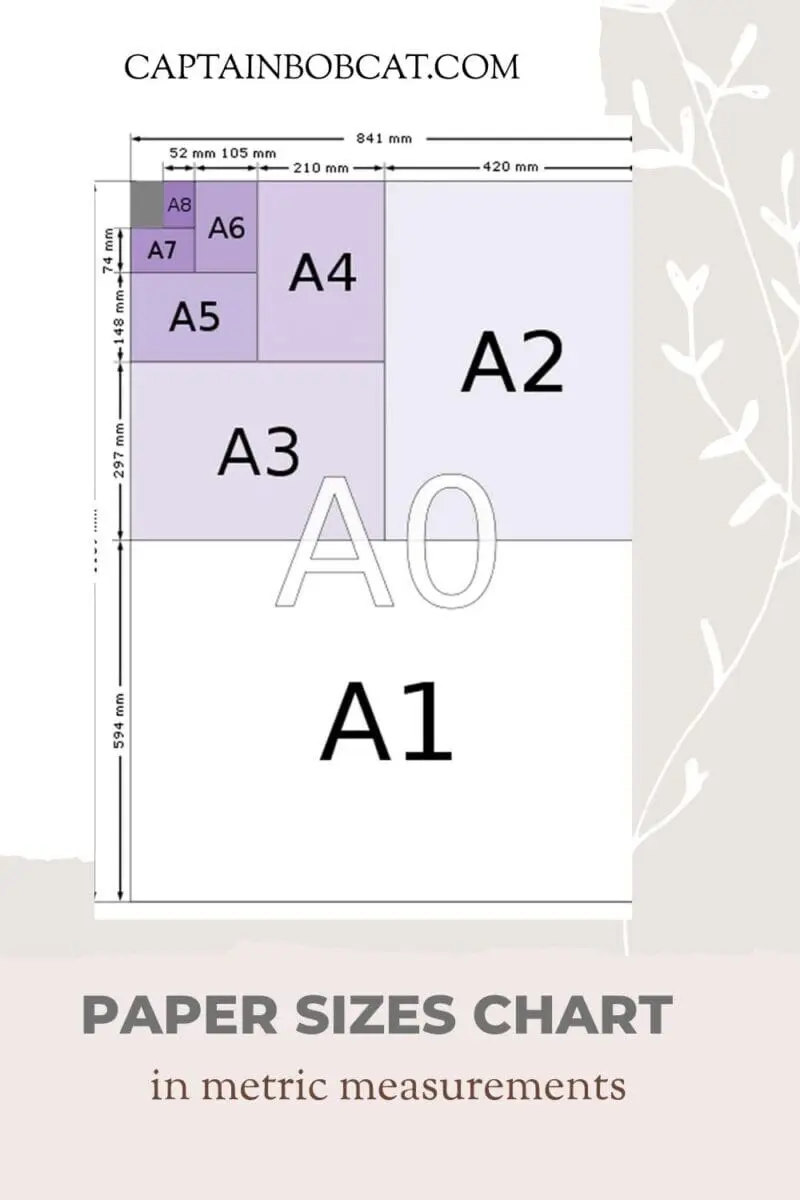
The Metric Unit System for Paper Sizes
I’m going to start with this, because this is what I use the most for framing photos and pictures.
The Metric system uses the ISO 216 standard, which features the A series of paper sizes. These sizes are based on a system that defines each size by halving the dimensions of the larger sizes. The most widely used sizes include:
A0
841 x 1189 mm (33.1 x 46.8 inches)
A0 is the largest size in the A series and is used for large posters and technical drawings.
A1
594 x 841 mm (23.4 x 33.1 inches)
Commonly used for engineering drawings, displays, and large graphics.
A2
420 x 594 mm (16.5 x 23.4 inches)
Often used for posters, advertisements, and art prints.
A3
297 x 420 mm (11.7 x 16.5 inches)
Popular for brochures, magazines, and diagrams. A3 is the equivalent of tabloid size in the Imperial units.
A4
210 x 297 mm (8.3 x 11.7 inches)
The most common paper size globally for documents, A4 is widely used in offices and educational settings.
A5
148 x 210 mm (5.8 x 8.3 inches)
Typically used for notepads and small notebooks.
A6
105 x 148 mm (4.1 x 5.8 inches)
This compact size is ideal for postcards and invitations.
A7-A10
These sizes continue to halve, with A7 measuring 74 x 105 mm (2.9 x 4.1 inches) down to A10 at 26 x 37 mm (1 x 1.5 inches), often used for small notes and tags.
The Imperial Unit System for Paper Sizes
In the United States, the most common paper sizes include:
Letter Size
8.5 x 11 inches (215.9 x 279.4 mm)
This is the standard paper size for business and personal correspondence.
Legal Size
8.5 x 14 inches (215.9 x 355.6 mm)
Commonly used for legal documents and contracts.
Tabloid Size
11 x 17 inches (279.4 x 431.8 mm)
This larger format is often employed for newspapers, brochures, and posters.
Half Letter
5.5 x 8.5 inches (139.7 x 215.9 mm)
Frequently used for small booklets or programs.
A4
8.27 x 11.69 inches (210 x 297 mm)
Although A4 isn’t part of the Imperial system, it’s worth noting as it is a very popular size globally. It is commonly used for letters, forms, and documents in many countries outside the U.S.
Paper Weight and Thickness
In addition to size, paper quality is often defined by its weight and thickness, which can also differ based on the metric or imperial system. In the Imperial system, paper weight is measured in pounds (lbs), while the Metric system uses grams per square meter (gsm).
Common Paper Weights:
- 20 lb (75 gsm): generally used for everyday printing.
- 24 lb (90 gsm): offers a sturdier feel, suitable for professional documents.
- 80 lb (215 gsm): commonly used for cardstock, brochures, and flyers.
The higher the gsm, the thicker and sturdier the paper. This distinction is crucial when choosing paper for specific printing needs.
How to Select the Appropriate Paper Size and Weight
- Selecting the appropriate paper size and weight largely depends on the type of project. For instance:
- Business Documents: A4 or Letter size is preferable, depending on geographic location.
- Posters and Marketing Material: A2 or A3 sizes are commonly selected for visibility and legibility.
- Crafts and DIY Projects: various sizes like A5 or A6 can be chosen based on the craft requirement.